Digital ACT vs. Digital SAT 2026: Format, Timing, Concordance
Anúncios
As high school students prepare for college admissions, navigating the fully computer-based testing landscape requires a clear comparison of the Digital ACT vs Digital SAT. Both standardized assessments have completely abandoned paper and pencil, but key structural differences determine which online exam aligns best with your test-taking strengths.
While both computer-based entrance exams test reading, writing, and mathematics, their digital delivery systems diverge significantly in pacing and question design.
The College Board’s assessment utilizes adaptive testing modules that adjust difficulty in real-time, whereas ACT’s electronic version retains a linear format with science reasoning and shorter per-question timing windows.
Choosing the right testing pathway depends on how you handle time pressure, adaptive scoring algorithms, and specialized section content. Here is a breakdown of the updated timing limits, scoring concordance tables, and structural nuances to help you decide which standardized test will maximize your score.
The Digital Transformation: A New Era for Standardized Testing
The move to digital platforms for both the ACT and SAT represents a fundamental change in standardized testing, impacting test-takers globally.
Anúncios
This transition is not merely about moving from paper to screen; it involves significant alterations to test design, administration, and student experience. Understanding these foundational changes is the first step in differentiating the Digital ACT vs Digital SAT.
Both organizations cite enhanced security, administrative efficiency, and a more accessible testing experience as primary drivers for this digital shift. While the underlying goal of assessing college readiness remains, the methods by which that assessment is conducted are being thoroughly modernized. This evolution demands a fresh look at preparation strategies and expectations.
The full implementation of these digital formats by 2026 means that upcoming cohorts of students will primarily encounter these new versions.
Anúncios
Therefore, detailed comparisons and analyses are becoming increasingly vital for making informed decisions about which test aligns best with individual student strengths and college aspirations. The landscape is changing, and staying ahead of these changes is key.
Key Motivations for Digital Shift
Enhanced Security: Digital tests offer improved measures against cheating and content theft, providing unique test forms to each student.
Administrative Efficiency: Streamlined registration, scoring, and proctoring processes reduce logistical burdens for test centers and administrators.
Accessibility and Equity: Digital formats can incorporate accommodations more seamlessly and potentially reach a wider range of students.
The digital format also allows for more dynamic question types and multimedia elements, which could evolve how certain skills are assessed. This potential for innovation could further distinguish the Digital ACT vs Digital SAT in the coming years. The goal is to make the tests more relevant to a digital-first generation.
As these tests become fully digital, the emphasis on digital literacy and comfort with online interfaces will naturally increase for test-takers.
This subtle but important shift means that students will need to be as comfortable navigating a digital testing environment as they are with the academic content itself. Preparation will extend beyond subject matter to include digital familiarity.
Comparing Exam Formats: Digital ACT vs. Digital SAT Structure
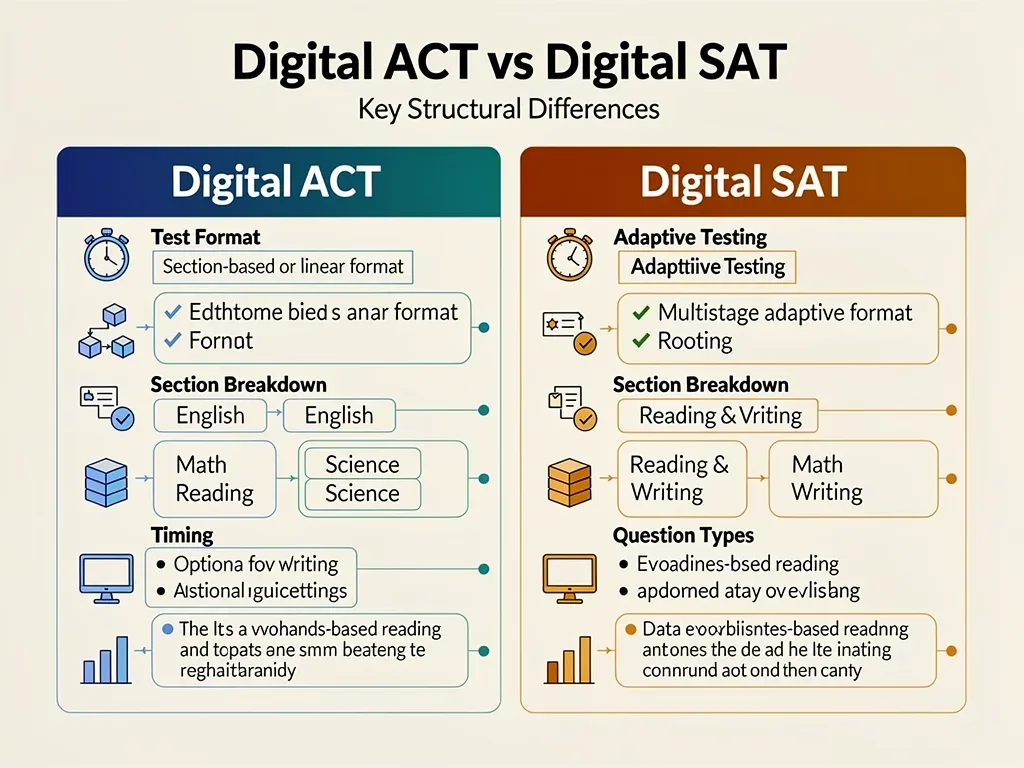
One of the most critical aspects when evaluating the Digital ACT vs Digital SAT is their fundamental exam structures. While both are moving to digital, their approaches to test design, section breakdown, and adaptive testing differ significantly. These structural differences will heavily influence a student's testing experience and performance.
The Digital SAT, introduced by College Board, has adopted an adaptive testing model, meaning the difficulty of subsequent sections adjusts based on a student's performance in earlier modules.
This adaptive nature is a major departure from the linear format of the traditional SAT and presents a unique challenge and opportunity for test-takers. Understanding this adaptability is crucial for preparation.
Conversely, the Digital ACT, while administered digitally, retains its linear, non-adaptive structure, much like its paper-and-pencil predecessor. This means all students receive the same set of questions within each section, regardless of their performance on prior questions.
This distinction in adaptive versus linear testing is perhaps the most defining characteristic when comparing the Digital ACT vs Digital SAT formats.
Digital SAT: Adaptive Testing Model
The Digital SAT consists of two main sections: Reading and Writing, and Math. Each of these sections is divided into two modules. The second module's difficulty level for both Reading and Writing, and Math, is determined by the student's performance on the first module of that respective section.
This adaptive nature means that strong performance in the initial module can lead to more challenging questions in the second, potentially allowing for higher scores.
This adaptive model results in a shorter overall test duration compared to the paper-based SAT, as fewer questions are needed to accurately assess a student's ability.
The questions are also more varied, incorporating a mix of multiple-choice and grid-in responses, with a built-in graphing calculator available for the entire Math section. This integrated tool changes the dynamics of how students approach mathematical problems.
Digital ACT: Linear Format Maintained
The Digital ACT maintains its four core sections: English, Math, Reading, and Science, with an optional Writing section.
Unlike the Digital SAT, the ACT's digital format is linear, meaning students encounter questions in a predetermined order, and the difficulty does not adjust based on their performance within the test. This consistency provides a familiar structure for students accustomed to the traditional ACT.
While the ACT offers a digital format, it is not universally available or mandated in all regions by 2026, though its adoption is increasing.
The digital version aims to mirror the paper test experience as closely as possible in terms of content and structure, focusing on ease of navigation and digital tools. The main difference is the delivery method, not a fundamental change in the test's design or question types.
Timing Limits and Test Duration: A Key Differentiator
The total time allocated and the time limits per section are crucial factors that influence student strategy and endurance. When analyzing the Digital ACT vs Digital SAT, significant differences emerge in their overall duration and pacing.
These variations can have a profound impact on a student's test-taking experience and their ability to perform optimally under time constraints.
The Digital SAT, with its adaptive format, has notably reduced its overall testing time, aiming for a more concise and efficient assessment. This shorter duration might appeal to students who experience test fatigue or prefer a more concentrated testing period. Understanding the new timing is essential for pacing strategies.
The Digital ACT, while also moving to a digital platform, largely maintains its traditional section-by-section timing, resulting in a slightly longer overall test duration compared to the new Digital SAT.
This distinction is vital for students to consider when deciding which test aligns better with their stamina and comfort level. Pacing remains a critical skill for both exams.
Digital SAT: Shorter, More Focused
The Digital SAT is designed to be approximately two hours and fourteen minutes long, a significant reduction from the previous paper-based version. This shorter duration is a direct result of its adaptive design, which allows for fewer questions while maintaining psychometric validity. The breakdown is as follows:
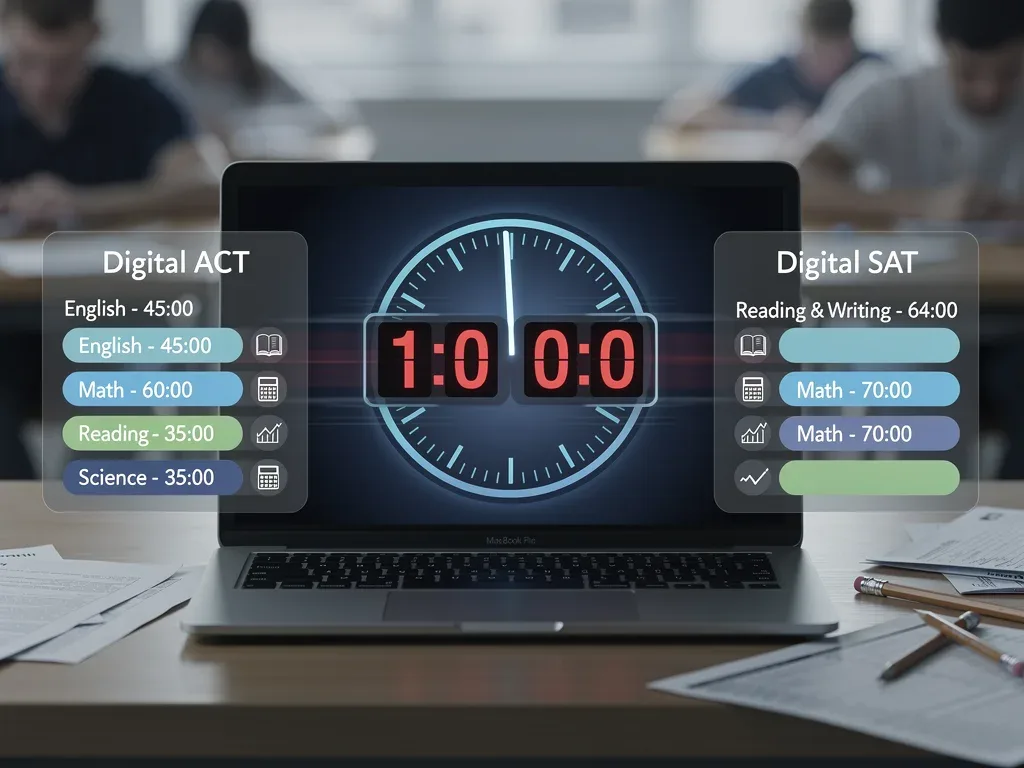
Reading and Writing: Two 32-minute modules, totaling 64 minutes.
Math: Two 35-minute modules, totaling 70 minutes.
Breaks: A 10-minute break between the Reading and Writing and Math sections, plus a short break between the two modules of the Math section.
This streamlined timing means students need to be highly efficient and focused throughout the test. The reduced duration might lessen test anxiety for some, but it also means less room for error within each module. Preparation must account for this increased intensity and faster pace, making every minute count.
Digital ACT: Consistent, Comprehensive
The Digital ACT, staying true to its linear format, maintains a test duration comparable to its paper counterpart. The total time for the four core sections is approximately two hours and fifty-five minutes, without the optional writing section. With the writing section, it extends to three hours and forty minutes. The section timings are:
English: 45 minutes for 75 questions.
Math: 60 minutes for 60 questions.
Reading: 35 minutes for 40 questions.
Science: 35 minutes for 40 questions.
Optional Writing: 40 minutes.
The Digital ACT's consistent timing allows students to manage their time across a larger number of questions in each section, similar to the traditional format.
This might be preferable for students who appreciate a more extended period to demonstrate their knowledge across various subjects. The familiarity of the pacing could reduce stress for those accustomed to the ACT's structure.
Scoring Mechanisms and Reporting: What Changes?
Understanding how scores are calculated and reported is fundamental for students and colleges alike when evaluating the Digital ACT vs Digital SAT. While both tests aim to provide a standardized measure of college readiness, their scoring scales and methods of score interpretation have distinct characteristics.
These differences can influence which test a student feels more confident taking and how colleges view their performance.
The Digital SAT continues to use a 1600-point scale, divided equally between the Reading and Writing section and the Math section.
The adaptive nature of the test ensures that scores are still reliable and comparable to previous SAT scores, despite the changes in format and duration. This consistency in the scoring scale helps maintain continuity for college admissions offices.
The Digital ACT retains its 36-point composite score, derived from the average of its four sections, each also scored on a 36-point scale. This familiar scoring system provides a clear and consistent metric for students and institutions. The stability of the ACT's scoring mechanism, despite the digital transition, allows for straightforward comparisons with past ACT scores.
Digital SAT Scoring Details
The Digital SAT's adaptive design ensures that a student's score is precisely determined by the difficulty and number of questions answered correctly. The scoring algorithm accounts for the adaptiveness, ensuring fairness and accuracy.
Each module's performance contributes to the overall section score (200-800 for Reading and Writing, 200-800 for Math), which then combine for the total 400-1600 scale. There is no penalty for incorrect answers, encouraging students to attempt every question.
The College Board provides detailed score reports, including subscores and cross-test scores that offer insights into specific academic strengths and areas for improvement.
These detailed analytics can be valuable for both students in their self-assessment and for colleges in their holistic review processes. The transparency in reporting helps students understand their performance beyond a single number.
Digital ACT Scoring Details
The Digital ACT's scoring remains straightforward: each of the four core sections (English, Math, Reading, Science) is scored from 1 to 36. These four scores are then averaged to produce a composite score, also ranging from 1 to 36.
The optional Writing section is scored separately on a scale of 2-12 and does not contribute to the composite score. Like the SAT, there is no penalty for incorrect answers on the ACT.
ACT score reports provide not only the composite and section scores but also detailed information on subscores and reporting categories, such as 'Ideas and Analysis' in the Reading section or 'Algebra' in the Math section.
This granular feedback helps students identify their proficiency in specific skill areas. The consistent scoring system makes the Digital ACT vs Digital SAT comparison easier for colleges.
Concordance Benchmarks: Bridging the Score Gap
Concordance tables play a critical role in college admissions, allowing institutions to compare scores from different standardized tests fairly. As both the ACT and SAT transition to digital formats, understanding the updated concordance benchmarks for the Digital ACT vs Digital SAT becomes even more essential.
These tables help translate scores between the two tests, ensuring that colleges can evaluate applicants consistently, regardless of which exam they took.
The College Board and ACT Inc. periodically release updated concordance tables to reflect any shifts in test design or scoring.
These tables are developed through rigorous statistical analysis to ensure that an equivalent score on one test corresponds to a similar level of academic achievement on the other. Students should consult the latest official concordance tools to accurately compare their scores.
For colleges, these benchmarks are indispensable for maintaining equity in their admissions processes, especially as students navigate the choice between the Digital ACT and Digital SAT.
The goal is to provide a common ground for evaluation, enabling institutions to make informed decisions. Staying current with these benchmarks is vital for all stakeholders in the admissions journey.
Official Concordance for Digital SAT
While the Digital SAT maintains the 400-1600 scoring scale, the College Board has provided updated concordance tables to align scores from the new digital format with the previous paper-based SAT and the ACT.
These tables are crucial for colleges that receive scores from both old and new formats, and from both testing organizations. The aim is to ensure continuity and fairness in score interpretation.
Students can use these official concordance tools to understand how their Digital SAT score might translate to an equivalent ACT score, and vice versa.
This can be particularly helpful when deciding which scores to submit to colleges that may have preferences or historical data based on one test over the other. The accuracy of these tables is critical for strategic score reporting.
Official Concordance for Digital ACT
Similarly, the ACT has released its own concordance tables that align Digital ACT scores with previous ACT scores and the SAT. Since the Digital ACT largely retains its content and scoring structure, the concordance with its paper predecessor is expected to be very strong. The primary focus of concordance for the Digital ACT is its relationship with the Digital SAT.
These tables allow students to gauge their performance relative to both tests, providing a clearer picture of their standing. Colleges rely on these official tools to compare applicants who may have taken different tests, ensuring a standardized approach to evaluating academic readiness.
The ongoing update of these concordance benchmarks highlights their importance in the evolving testing landscape.
Preparation Strategies for the Digital Exams
The transition to digital formats demands a recalibration of preparation strategies for both the Digital ACT vs Digital SAT.
While core academic content remains paramount, familiarity with the digital interface, adaptive testing nuances (for the SAT), and efficient use of on-screen tools are now equally critical. Students cannot rely solely on traditional paper-based study methods.
For the Digital SAT, practice with adaptive modules and understanding how performance in earlier sections impacts later ones is key.
Students should also become proficient with the built-in graphing calculator and digital annotation tools. These elements are integral to the test experience and require dedicated practice to master effectively.
For the Digital ACT, practice with the digital platform's navigation, question display, and any available digital scratchpad features is essential.
Although the test is linear, comfort with the online environment can significantly reduce test-day anxiety and improve focus. Tailoring preparation to the specific digital features of each exam is now non-negotiable.
Digital SAT Preparation Focus
Students preparing for the Digital SAT should prioritize official practice tests provided by the College Board, particularly those that simulate the adaptive format. Utilizing Khan Academy's resources, which are specifically designed for the Digital SAT, can also be highly beneficial. Focus should be placed on:
Adaptive Module Practice: Understand how performance in the first module influences the second.
Calculator Proficiency: Become adept at using the built-in graphing calculator for all math problems.
Digital Tools: Practice with highlighting, annotation, and flagging questions within the digital interface.
Furthermore, managing time effectively within the shorter, more intense sections is crucial. Students should practice answering questions accurately and efficiently, knowing that every question contributes significantly to their module performance. The ability to quickly identify and solve problems under pressure is more important than ever.
Digital ACT Preparation Focus
For the Digital ACT, preparation should still heavily emphasize content mastery across all four sections (English, Math, Reading, Science). However, it is equally important to engage with official digital practice tests provided by ACT Inc. to familiarize oneself with the online platform. Key areas of focus include:
Digital Navigation: Practice moving between questions, sections, and using any digital tools provided.
Time Management: Maintain strong pacing strategies for each section, as the linear format requires consistent speed.
Science Reasoning: Continue to develop strong data interpretation and analytical skills, which are central to the ACT Science section.
Students should also ensure they are comfortable reading passages and interpreting graphics on a screen for extended periods. Building digital stamina can help prevent eye strain and maintain focus throughout the test. The goal is to make the digital format feel as natural as possible.
Accessibility and Accommodations in the Digital Era
The shift to digital testing for both the Digital ACT vs Digital SAT brings both opportunities and challenges concerning accessibility and accommodations for students with disabilities.
Both testing organizations are committed to providing equitable access, but the implementation of accommodations in a digital environment requires careful consideration and specific procedures. Understanding these processes is vital for eligible students and their families.
Digital platforms offer the potential for more seamless integration of certain accommodations, such as extended time, screen readers, and customizable display settings.
However, the nature of digital delivery also means that specific types of accommodations might need to be re-evaluated or adapted. Proactive communication with the testing organizations is always recommended to ensure appropriate support.
For students requiring accommodations, it is crucial to apply for and receive approval well in advance of their test date. The digital format does not automatically simplify the approval process, but it can enhance the delivery of approved supports. Ensuring a fair and accessible testing experience remains a top priority for both the ACT and College Board.
Digital SAT Accommodations
The College Board aims to provide consistent accommodations for the Digital SAT as were available for the paper-based test. These include extended time, breaks, and assistive technology.
The digital platform can facilitate some of these, for example, by easily adjusting font sizes or color contrasts. However, students must still follow the standard application process through their schools or directly with the College Board.
The adaptive nature of the Digital SAT does not alter the availability of approved accommodations. Students with extended time will receive it for each module, maintaining the same proportional increase as on the traditional test. It is important for students and educators to review the College Board's specific guidelines for digital test accommodations to ensure all needs are met.
Digital ACT Accommodations
The ACT also continues to offer a range of accommodations for its digital test, consistent with those provided for the paper version. These include extended time, testing with a reader, and other specialized supports.
The digital format can simplify the delivery of some of these, for instance, by providing built-in text-to-speech options or screen magnification. Application for accommodations must be made through the student's school and approved by ACT Inc.
Given the linear format of the Digital ACT, the implementation of extended time typically follows the same structure as the paper test, providing additional time per section.
Students should confirm with their school and ACT Inc. the specific details of how their approved accommodations will be administered in the digital environment. Ensuring clarity on these provisions helps students focus on their performance.
Impact on College Admissions: What Colleges Are Looking For
The ongoing evolution of standardized tests, particularly the comparison between the Digital ACT vs Digital SAT, inevitably raises questions about their impact on college admissions.
While many institutions have adopted test-optional policies, for those that still require or recommend scores, understanding these new formats is paramount. Colleges are adapting their evaluation processes to account for the changes.
Admissions offices will continue to look for evidence of academic readiness and potential, regardless of the test format. The move to digital is intended to enhance the testing experience and provide reliable data, not fundamentally alter what colleges value. However, the nuances of each digital test might subtly influence how scores are perceived in a holistic review.
Students should focus on performing their best on the test that aligns with their strengths and then leverage official concordance tools to understand how their scores compare.
Colleges will continue to use scores as one component among many, including GPA, essays, recommendations, and extracurriculars, to assess an applicant's overall profile. The emphasis remains on a comprehensive review.
College Board's Perspective on Digital SAT
The College Board asserts that the Digital SAT provides a more relevant and engaging assessment, reflecting skills critical for success in college and careers.
They emphasize that the scores remain comparable to previous SAT scores, ensuring that colleges can continue to use them confidently. The aim is to make the test more student-friendly while maintaining its predictive validity.
Colleges are being provided with resources and data to understand the new format and how it relates to their admissions criteria. The College Board is actively engaging with institutions to ensure a smooth transition and consistent interpretation of Digital SAT scores. The focus is on providing reliable and actionable data for admissions decisions.
ACT Inc.'s Perspective on Digital ACT
ACT Inc. maintains that the Digital ACT continues to measure college and career readiness effectively, preserving the test's long-standing design and content.
Their digital format offers flexibility in administration while upholding the integrity and reliability of the assessment. The continuity in test structure aims to ease the transition for both students and colleges.
The ACT is working with colleges to ensure they have the necessary information and tools to interpret Digital ACT scores in the context of their admissions processes.
Institutions can expect the Digital ACT scores to be consistent with past ACT scores, allowing for straightforward comparisons within their applicant pools. The emphasis is on providing a familiar and trusted measure of academic achievement.
Key Feature | Digital ACT vs Digital SAT |
|---|---|
Exam Format | Digital SAT is adaptive; Digital ACT is linear. |
Total Duration | Digital SAT ~2h 14m; Digital ACT ~2h 55m (without writing). |
Scoring Scale | Digital SAT 400-1600; Digital ACT 1-36 composite. |
Calculator Use | Digital SAT allows calculator for all Math; Digital ACT for Math section only. |
Frequently Asked Questions About Digital ACT vs Digital SAT
What is the primary difference in format between the Digital ACT and Digital SAT?▼
The primary difference is that the Digital SAT is an adaptive test, meaning question difficulty adjusts based on performance, leading to a shorter duration. The Digital ACT, while digital, maintains a linear, non-adaptive format, with all students receiving the same set of questions within each section.
How do the timing limits compare for the Digital ACT vs Digital SAT?▼
The Digital SAT is significantly shorter, lasting approximately 2 hours and 14 minutes. The Digital ACT's core sections take about 2 hours and 55 minutes, similar to its paper predecessor. This duration difference is crucial for students to consider based on their test-taking stamina and pacing preferences.
Will colleges view scores from the Digital ACT and Digital SAT differently?▼
Colleges will continue to use official concordance tables to compare scores between the Digital ACT and Digital SAT fairly. Both testing organizations emphasize score comparability with previous versions. Institutions will still conduct holistic reviews, with test scores being one component among many in the application process.
Are there changes in calculator usage for the digital exams?▼
Yes, the Digital SAT allows students to use a built-in graphing calculator for the entirety of its Math section. The Digital ACT continues to permit calculator use only on its dedicated Math section, as with the paper version. This can impact preparation strategies for the math components.
How should students prepare for the new digital formats?▼
Preparation should now include extensive practice with official digital tests to familiarize students with the interface, digital tools, and pacing. For the Digital SAT, understanding adaptive testing is key. For the Digital ACT, digital navigation comfort is essential, alongside content mastery. Both require digital literacy.
What this means
The ongoing transition to digital formats for both the ACT and SAT represents a pivotal moment in standardized testing, demanding careful attention to the nuances of the Digital ACT vs Digital SAT. Students and educators must adapt their preparation strategies to account for new exam structures, timing, and digital interfaces.
Staying informed about official updates and concordance benchmarks is crucial for navigating college admissions successfully in this evolving landscape. The shift underscores the importance of digital literacy alongside academic readiness, shaping future test-taking experiences and college application processes.