Federal Reserve Holds Benchmark Interest Rate Steady at 4.25%
Anúncios
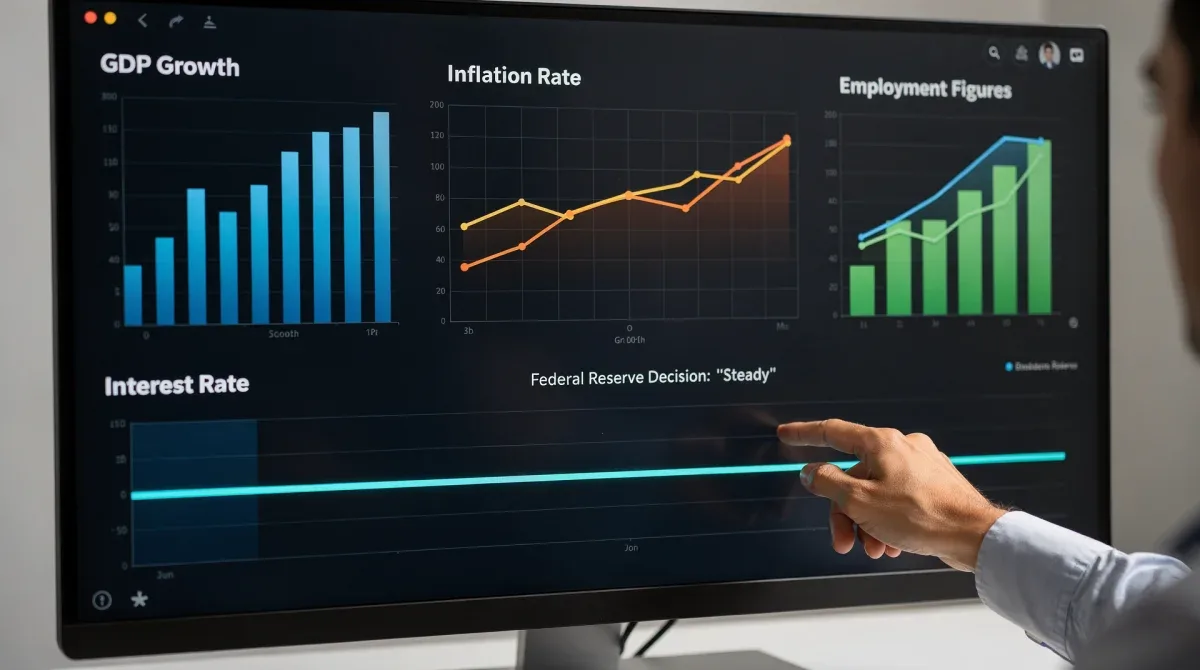
Wondering what the central bank's latest policy pause means for your mortgage, savings yield, or investment portfolio? The Federal Reserve’s decision to hold its benchmark Interest Rate Steady at 4.25% signals a measured approach as policymakers weigh cooling inflation against resilient labor data.
Alongside the FOMC policy statement, updated economic projections offer fresh clues about where borrowing costs, GDP growth, and employment are headed next. Maintaining the current federal funds target keeps pressure on consumer credit while preserving attractive returns on high-yield cash accounts.
Whether you are planning a major financing move or rebalancing your market exposure, reading between the lines of the Fed's outlook is essential. Here is what changed in the official forecast and how it impacts your wallet.
Federal Reserve's Benchmark Interest Rate Decision Explained
The Federal Reserve's decision to hold the benchmark interest rate steady at 4.25% marks a significant moment in current monetary policy. This stability reflects a careful assessment of various economic indicators, aiming to foster an environment conducive to long-term economic health.
Policymakers considered a broad range of data, including recent inflation trends, labor market strength, and global economic developments. The consensus was to maintain the current rate, allowing previous policy adjustments more time to fully impact the economy.
Anúncios
This steady stance is intended to provide predictability for businesses and consumers, encouraging investment and spending while continuing to monitor inflationary pressures. The Federal Reserve's commitment to data-driven decisions remains paramount in its operational framework.
Key Factors Influencing the Rate Hold
Several critical economic factors contributed to the Federal Reserve's decision to keep the benchmark interest rate at 4.25%. Among these, the most prominent were persistent inflationary pressures and a robust, albeit cooling, labor market.
The Fed's analysis indicated that while inflation has shown signs of moderation, it has not yet consistently reached the target level. Therefore, maintaining the current interest rate allows the central bank to continue its fight against elevated prices without stifling economic activity.
Anúncios
Furthermore, the strength of the job market, characterized by low unemployment rates and steady wage growth, provided the Federal Reserve with the flexibility to hold rates. This balance allowed policymakers to avoid further tightening that might destabilize employment.
Inflationary trends remain elevated but show signs of easing.
The labor market continues to exhibit strength with low unemployment.
Global economic uncertainties necessitate a cautious approach.
Previous rate hikes are still working their way through the economy.
Official Economic Forecast: A Deeper Dive
The release of the Federal Reserve's official economic forecast provides an invaluable window into the central bank's perspective on the nation's financial trajectory. This detailed outlook covers projections for key metrics such as Gross Domestic Product (GDP), inflation, and unemployment over the coming years.
These forecasts are crucial for businesses and investors, as they inform strategic planning and market expectations. The Federal Reserve's projections serve as a baseline for understanding potential economic shifts and their implications across various sectors.
The forecast also highlights potential risks and opportunities, outlining scenarios that could influence future monetary policy decisions. Understanding these projections is essential for anyone seeking to navigate the complex economic landscape effectively.
GDP Growth Projections and Their Significance
The Federal Reserve's latest economic forecast includes updated projections for GDP growth, offering insights into the anticipated pace of economic expansion. These figures are critical indicators of overall economic health and productivity.
According to the official statement, the Fed anticipates moderate GDP growth in the near term, reflecting a gradual normalization of economic activity. This projection suggests a resilient economy capable of absorbing current challenges while avoiding a significant downturn.
The significance of these GDP forecasts lies in their ability to shape expectations for corporate earnings, employment opportunities, and consumer confidence. A stable growth outlook supports investment and long-term planning for businesses.
The Federal Reserve's outlook on GDP growth remains cautiously optimistic. It suggests that while challenges persist, the underlying strength of the U.S. economy is expected to facilitate continued, albeit slower, expansion.
Inflation Outlook and the Path to Price Stability
The Federal Reserve's inflation outlook remains a central component of its policy statement, detailing the central bank's strategy to achieve its 2% target. Policymakers are closely monitoring various price indices to gauge the effectiveness of current monetary tightening.
The official forecast indicates a gradual decline in inflation over the next year, moving closer to the Fed's long-term objective. This projection is based on anticipated moderation in demand and the easing of supply chain constraints.
Achieving price stability is paramount for sustained economic prosperity, as high inflation erodes purchasing power and creates economic uncertainty. The Federal Reserve's commitment to this goal is unwavering, guiding its future policy actions.
Understanding the Fed's Inflationary Targets
The Federal Reserve maintains a long-run inflation target of 2%, measured by the personal consumption expenditures (PCE) price index. This target is considered optimal for fostering maximum employment and stable prices, two pillars of the Fed's mandate.
The current inflation outlook suggests a trajectory towards this 2% goal, though the path may not be entirely smooth. The Federal Reserve acknowledges that external factors and unforeseen economic shifts could influence this progression.
Policymakers use various tools, including interest rate adjustments, to steer inflation towards this target. The current steady interest rate reflects a belief that existing measures are sufficient to guide inflation lower without causing undue economic distress.
The 2% PCE inflation target is a key policy objective.
Current projections show a gradual decline in inflation.
Supply chain improvements and moderating demand are critical.
The Federal Reserve is prepared to adjust policy as needed.
Labor Market Projections and Employment Stability
The Federal Reserve's assessment of the labor market is another critical element of its economic forecast and policy statement. Projections for unemployment rates and employment growth provide insights into the health and resilience of the U.S. workforce.
The latest forecast indicates continued strength in the labor market, with unemployment expected to remain relatively low. This stability is a positive sign for household incomes and consumer confidence, supporting overall economic activity.
The Federal Reserve emphasizes that a strong labor market is essential for broad-based economic prosperity. Its policy decisions aim to sustain employment gains while addressing other economic objectives.
Despite some signs of cooling, the labor market has demonstrated remarkable resilience. The Federal Reserve is carefully watching for any shifts that could impact its dual mandate of maximum employment and price stability.
Implications for Consumers and Businesses
The Federal Reserve's decision to hold the benchmark interest rate steady at 4.25% carries significant implications for both consumers and businesses across the United States. This stability can influence borrowing costs, investment decisions, and overall economic sentiment.
For consumers, a steady interest rate typically means that rates on mortgages, auto loans, and credit cards are less likely to see immediate increases. This can provide a sense of predictability for household budgeting and major purchases.
Businesses, in turn, can benefit from a more stable lending environment, potentially making it easier to plan for expansion, hire new employees, and manage operational costs. The Federal Reserve's policy aims to foster a conducive environment for sustained economic activity.
Impact on Borrowing Costs and Investment
The stability of the Federal Reserve's benchmark interest rate directly influences borrowing costs across the economy. Lenders often adjust their rates in response to the Fed's policy, affecting everything from personal loans to corporate debt.
When the Federal Reserve Holds Benchmark Interest Rate Steady at 4.25%: Official Economic Forecast and Policy Statement, it creates a more predictable environment for businesses considering new investments. Lower uncertainty around borrowing costs can encourage capital expenditure and innovation.
Conversely, consumers may find that mortgage rates, while not falling, are also not rising dramatically, offering a window of stability for home purchases or refinancing. The overall impact is a tempering of volatility in financial markets.
This steady rate environment helps both individuals and corporations make more informed financial decisions, reducing some of the speculative pressures that can arise during periods of rapid rate changes. The Federal Reserve hopes this stability will translate into sustained economic confidence.

Future Monetary Policy Outlook
The Federal Reserve's policy statement provides crucial signals regarding the future direction of monetary policy. While the current decision is to hold rates steady, the central bank maintains its flexibility to adjust as economic conditions evolve.
Policymakers will continue to closely monitor incoming data, including inflation reports, employment figures, and global economic developments. Any significant shifts in these indicators could prompt a reconsideration of the current stance.
The Federal Reserve's commitment to a data-dependent approach means that future decisions will be guided by the prevailing economic landscape. This adaptability is key to effectively managing the nation's financial health.
Potential Scenarios for Future Rate Adjustments
While the Federal Reserve Holds Benchmark Interest Rate Steady at 4.25%: Official Economic Forecast and Policy Statement, several potential scenarios could lead to future rate adjustments. These depend heavily on how economic data unfolds in the coming months.
If inflation proves more persistent than anticipated, the Federal Reserve might consider further rate hikes to cool the economy. Conversely, a significant weakening of the labor market or a sharp economic downturn could prompt rate cuts.
The Federal Reserve's forward guidance emphasizes that each meeting's decision is independent and based on the most current information available. This approach prevents pre-commitment to a specific path, allowing for maximum flexibility.
Persistent inflation could lead to further rate hikes.
Economic downturn or weak labor market might trigger rate cuts.
Data dependency remains the cornerstone of future policy.
Global economic developments will also play a role in decisions.
Global Economic Context and the Fed's Decision
The Federal Reserve's decision to hold the benchmark interest rate steady at 4.25% is not made in isolation; it is deeply intertwined with the broader global economic context. International developments significantly influence domestic economic conditions and the Fed's policy considerations.
Global inflation trends, geopolitical events, and the economic performance of major trading partners all factor into the Federal Reserve's calculus. These external forces can impact U.S. trade, supply chains, and financial markets.
The Federal Reserve's policy statement acknowledges these global linkages, highlighting the need for a comprehensive understanding of both domestic and international economic dynamics. This holistic view ensures that policy decisions are well-informed and robust.
The stability provided by the Federal Reserve Holds Benchmark Interest Rate Steady at 4.25%: Official Economic Forecast and Policy Statement can also have ripple effects internationally, influencing currency exchange rates and capital flows. This demonstrates the interconnectedness of global financial systems.
Key Point | Brief Description |
|---|---|
Interest Rate Held | Benchmark interest rate maintained at 4.25%. |
Economic Forecast | Projections for GDP, inflation, and unemployment released. |
Policy Statement | Details rationale for current monetary policy stance. |
Market Impact | Influences borrowing costs and investment decisions. |
Frequently Asked Questions About the Federal Reserve's Decision
Why did the Federal Reserve hold the interest rate steady?▼
The Federal Reserve held the rate steady at 4.25% to allow previous rate hikes to fully impact the economy. This decision reflects a balance between controlling inflation and sustaining economic growth, based on current data showing moderating inflation and a resilient labor market. It indicates a cautious approach to ensure stability.
What does the official economic forecast predict for inflation?▼
The official economic forecast projects a gradual decline in inflation over the next year, moving towards the Federal Reserve's long-term target of 2%. This outlook is based on expectations of moderating demand and easing supply chain issues, signaling a hopeful path towards price stability.
How does this decision affect consumers' borrowing costs?▼
A steady benchmark interest rate means that rates on consumer loans, such as mortgages, auto loans, and credit cards, are less likely to see immediate increases. This provides a degree of predictability for households, potentially encouraging major purchases and supporting financial planning without sudden shifts.
What are the implications for the U.S. labor market?▼
The Federal Reserve's forecast anticipates continued strength in the labor market, with unemployment rates expected to remain relatively low. This stability supports household incomes and consumer confidence, which are vital for overall economic health. The Fed aims to sustain these employment gains.
Could the Federal Reserve change its interest rate policy soon?▼
While the Federal Reserve Holds Benchmark Interest Rate Steady at 4.25%: Official Economic Forecast and Policy Statement, future policy remains data-dependent. Any significant shifts in economic data, such as persistent inflation or a weakening labor market, could prompt adjustments. The Fed maintains flexibility to respond to evolving conditions, avoiding pre-commitment.
Looking Ahead: What This Means
The Federal Reserve's decision to hold the benchmark interest rate steady at 4.25% provides a period of relative stability for the U.S. economy. This move, coupled with the official economic forecast and policy statement, offers a clear indication of the central bank's strategy to navigate ongoing economic challenges.
Moving forward, it will be crucial to monitor key economic indicators such as inflation, employment, and GDP growth, as these will heavily influence the Federal Reserve's subsequent policy decisions. The central bank's data-dependent approach means that flexibility remains a cornerstone of its strategy, allowing for adjustments as conditions evolve.
For consumers and businesses, this stability offers a degree of predictability in borrowing costs and financial planning. However, staying informed about future Federal Reserve announcements and economic reports will be essential to anticipate potential shifts and adapt strategies accordingly.